Key Takeaways
- Product waste accounts for 8–15% of revenue at spas without inventory tracking systems
- Use the Reorder Point formula to automate purchasing: ROP = (Daily Usage × Lead Time) + Safety Stock
- Track cost per service to understand true margins (most spas overestimate margins by 10–20%)
- FIFO rotation and weekly expiry checks reduce spoilage by 40–60% for oils and skincare
- Monthly physical audits should find <2% variance — anything higher signals theft or recording errors
Step 1: Categorize Your Spa Inventory
Not all inventory behaves the same. Divide your stock into four categories, each needing different tracking frequency and reorder strategies:
| Category | Examples | Tracking Frequency | Typical Lead Time | Shelf Life |
|---|---|---|---|---|
| Consumables | Massage oils, creams, scrubs, essential oils, disposable items (headrest covers, slippers) | Daily deduction per service | 3–7 days (local), 14–30 days (imported) | 6–24 months |
| Retail Products | Skincare, body care, aromatherapy candles, gift sets | Per sale (POS-linked) | 7–14 days (local), 30–60 days (imported) | 12–36 months |
| Linens & Supplies | Towels, robes, sheets, blankets, laundry supplies | Weekly count | 7–14 days | 12–24 months (usable life) |
| Equipment | Hot stones, massage tables, steamers, UV sterilizers | Monthly/quarterly review | 14–60 days | 3–10 years |
💡 ABC Classification
Apply the 80/20 rule: A items (20% of SKUs, 80% of cost) — massage oils, premium creams — need tight control. B items (30% of SKUs, 15% of cost) — towels, disposables — moderate control. C items (50% of SKUs, 5% of cost) — cotton pads, clips — simple reorder.
Step 2: Calculate Reorder Points
The reorder point tells you exactly when to place a purchase order so you never run out of stock — and never over-order.
Reorder Point (ROP) Formula
Example: Massage Oil Reorder Point
Your spa uses 2.5 liters of massage oil per day. Your supplier delivers in 5 business days. You want 3 days of safety stock.
Economic Order Quantity (EOQ)
Determines the optimal order size that minimizes total annual inventory costs (ordering cost + holding cost):
Step 3: Calculate Cost Per Service
Knowing your exact product cost per service is critical for setting profitable prices. Most spas guess — and overestimate their margins by 10–20%.
Example: Thai Oil Massage (1 Hour) — Full Cost Breakdown
| Item | Amount Used | Unit Price | Cost per Service |
|---|---|---|---|
| Massage oil | 30 ml | ฿8/ml | ฿240 |
| Essential oil blend | 3 ml | ฿25/ml | ฿75 |
| Disposable headrest cover | 1 piece | ฿5/piece | ฿5 |
| Disposable underwear | 1 piece | ฿12/piece | ฿12 |
| Hot towel (laundry cost) | 2 towels | ฿8/wash | ฿16 |
| Sheet laundering | 1 set | ฿15/wash | ฿15 |
| Total Product Cost: | ฿363 | ||
If you charge ฿1,200 for the service and pay 35% commission (฿420), your actual margin is:
⚠️ Hidden Costs to Track
Don't forget: laundry costs (฿12–฿20/load), cleaning products (room turnover), water/electricity for hot stones/steamers, and product spillage/waste (typically 5–10% of consumables). These add ฿50–฿100 per service at most spas.
Step 4: Reduce Product Waste
Thai spas lose 8–15% of product value to waste, expiry, and over-use. Here are the five strategies that cut waste most effectively:
4.1 Pre-Measure Consumables
Instead of letting therapists pour products freely, use pre-measured containers for each service type. A ฿200 set of pump bottles with marked measurements pays for itself within a week:
- Thai massage: No oil (or 10ml if requested)
- Oil massage: 25–30ml per service
- Aromatherapy: 30ml oil + 3ml essential oil
- Body scrub: 80–100g scrub product
Impact: Reduces oil over-use by 15–25% immediately.
4.2 FIFO (First In, First Out)
Always use older stock before newer stock. Place new deliveries at the back of shelves, older stock at the front. Label each item with the date opened.
For oils: Most carrier oils last 6–12 months after opening. Essential oils last 1–3 years. Once opened, mark the date on the bottle with a permanent marker.
4.3 Weekly Expiry Checks
Assign one person to check expiry dates every Monday. Create a simple checklist:
- Pull any item expiring within 30 days to a "use first" shelf
- Items expiring within 7 days — use for staff training sessions or discard
- Record all expired items as waste (track the THB value lost)
4.4 Track Variance Monthly
Common causes of high variance: unmeasured usage, spillage not recorded, theft, recording errors (entered 10 instead of 1), or supplier short-delivery.
4.5 Supplier Management
Maintain at least two suppliers for high-value items (A category). This gives you:
- Price leverage: competitive bidding reduces cost 5–15%
- Supply security: if one supplier is out of stock, you have a backup
- Quality comparison: you can benchmark product quality
Step 5: Monthly Inventory Audits
A physical count every month keeps your inventory accurate and catches issues early. Here's an efficient audit process for spas with 50–200 SKUs:
Audit Day Checklist
- Pre-audit: Print current stock levels from your system. Sort by category.
- Count: Two people — one counts, one records. Work through one shelf/area at a time.
- Compare: Match physical count to system count. Flag any item with >2% variance.
- Investigate: For flagged items, check recent usage logs, delivery records, and waste records.
- Adjust: Update system counts to match physical counts. Document the reason for each adjustment.
- Report: Calculate total variance value (THB). Track month-over-month trend.
| Metric | Target | Warning | Critical |
|---|---|---|---|
| Overall variance rate | <2% | 2–5% | >5% |
| Expired product value/month | <฿2,000 | ฿2,000–฿5,000 | >฿5,000 |
| Stockout incidents/month | 0 | 1–2 | 3+ |
| Inventory turnover ratio | 8–12×/year | 4–7×/year | <4×/year |
Key Inventory KPIs for Spa Owners
Example: Monthly KPI Dashboard
| KPI | January | February | March | Trend |
|---|---|---|---|---|
| Inventory value | ฿185,000 | ฿172,000 | ฿168,000 | Improving |
| Product cost per service | ฿380 | ฿365 | ฿355 | Improving |
| Waste rate | 5.2% | 3.8% | 2.9% | Improving |
| Stockout incidents | 3 | 1 | 0 | Improving |
| Audit variance | 4.1% | 2.8% | 1.5% | Improving |
📊 Real Results
Thai spas that implement systematic inventory tracking typically see: 20–30% reduction in product waste within the first 3 months, 15% reduction in inventory carrying costs (less over-ordering), and zero stockouts once reorder points are calibrated (usually by month 2). The net impact is a 5–8% improvement in overall profit margin.
Automate Inventory Tracking
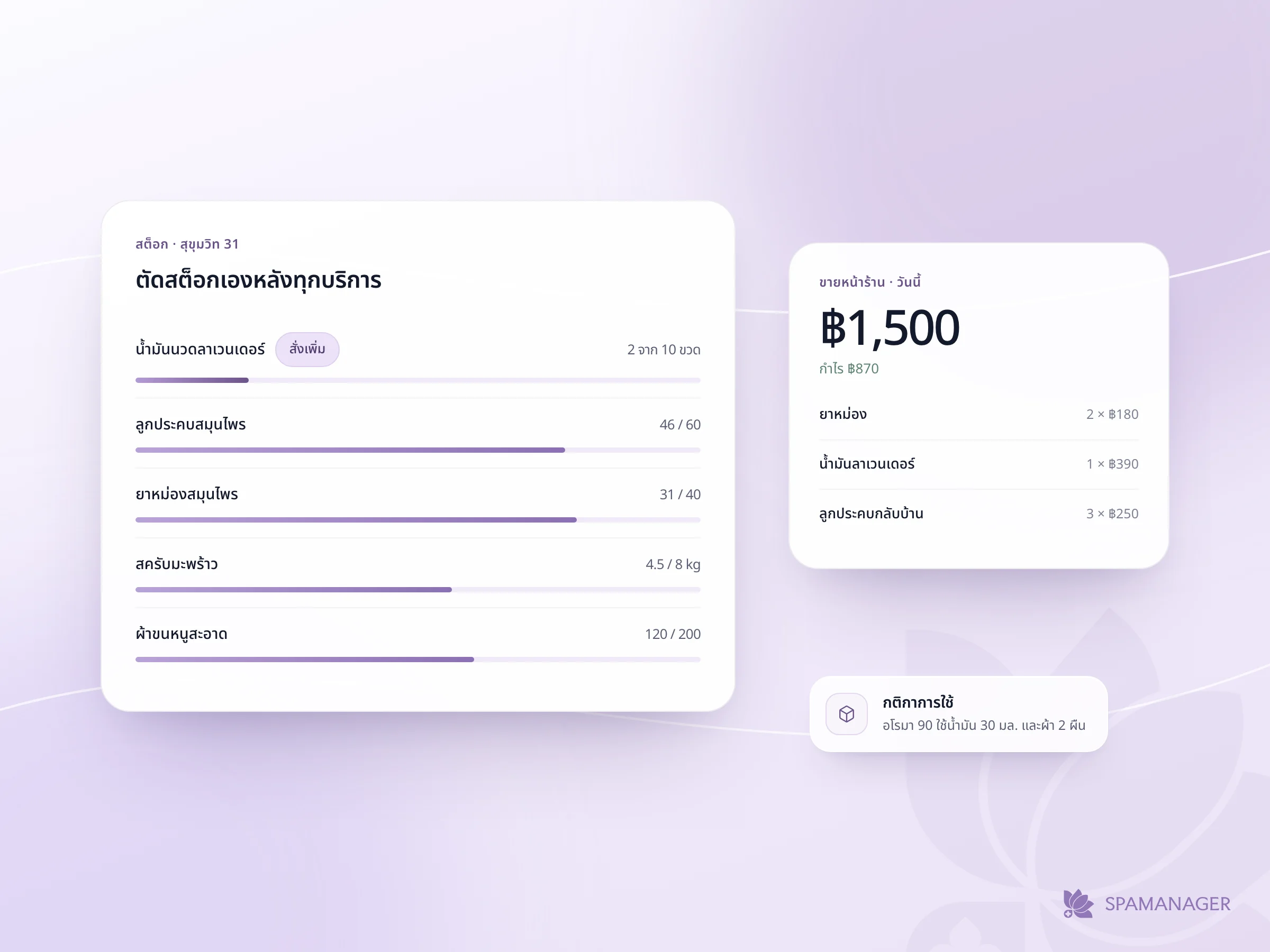
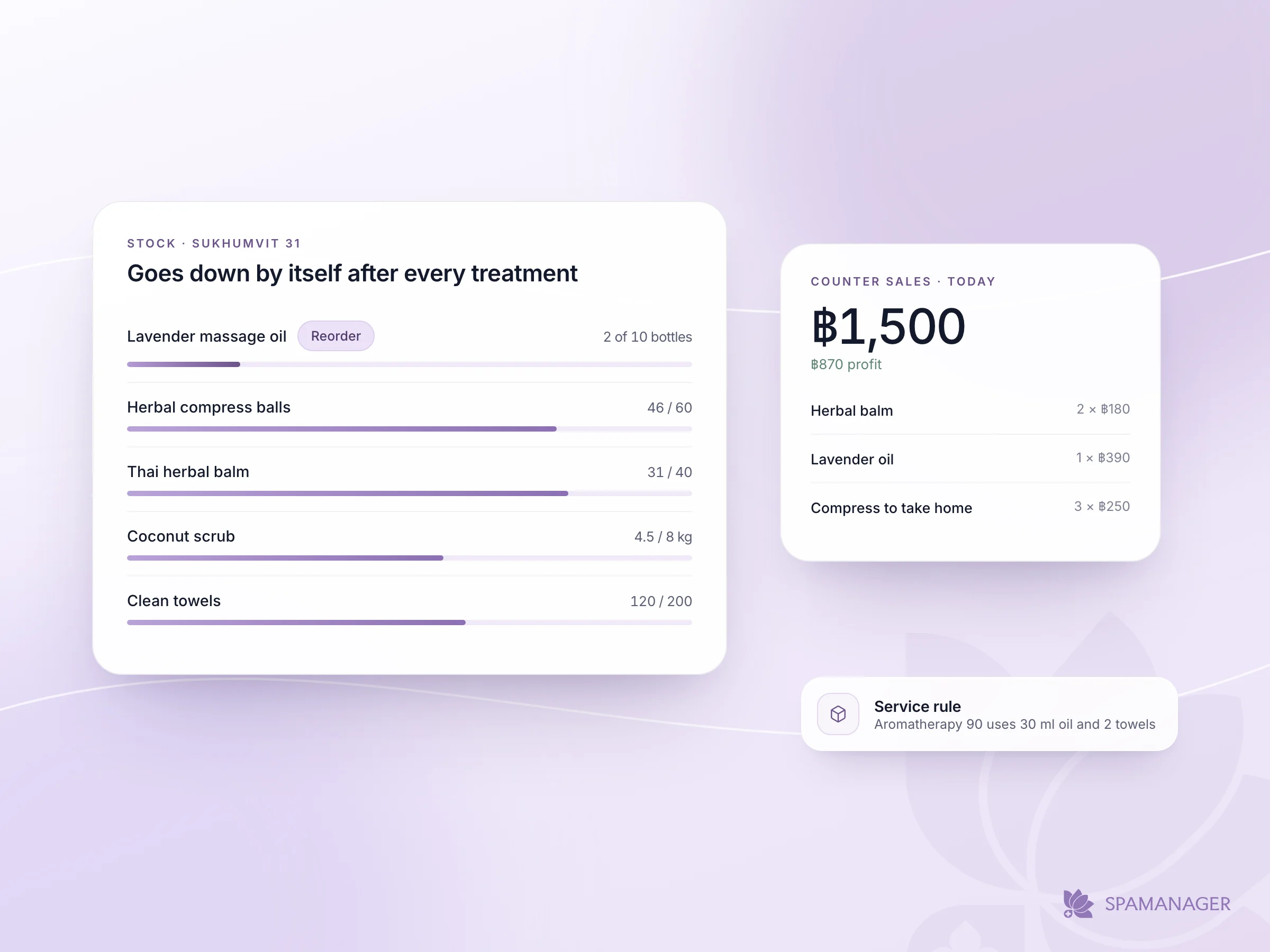
SpaManager tracks product usage per service, calculates reorder points automatically, and sends low-stock alerts before you run out.
Start Free Trial →